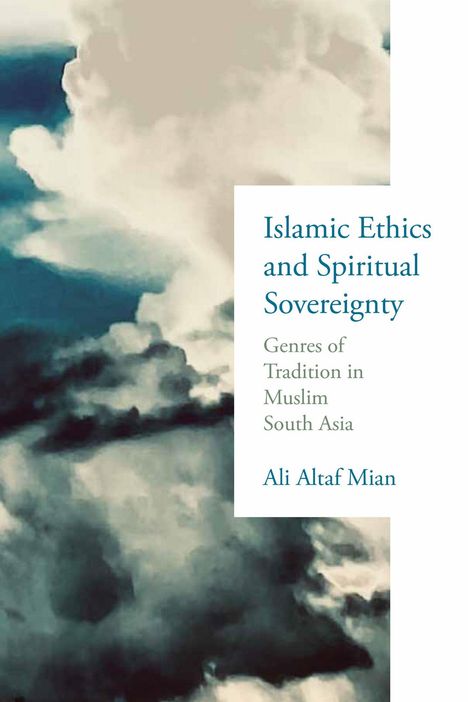
Ali Altaf Mian: Islamic Ethics and Spiritual Sovereignty, Gebunden
Islamic Ethics and Spiritual Sovereignty
- Genres of Tradition in Muslim South Asia
(soweit verfügbar beim Lieferanten)
- Verlag:
- University of Notre Dame Press, 06/2026
- Einband:
- Gebunden
- Sprache:
- Englisch
- ISBN-13:
- 9780268210908
- Artikelnummer:
- 12622598
- Umfang:
- 460 Seiten
- Gewicht:
- 812 g
- Maße:
- 229 x 152 mm
- Stärke:
- 25 mm
- Erscheinungstermin:
- 15.6.2026
- Hinweis
-
Achtung: Artikel ist nicht in deutscher Sprache!
Weitere Ausgaben von Islamic Ethics and Spiritual Sovereignty |
Preis |
|---|---|
| Buch, Kartoniert / Broschiert, Englisch | EUR 57,60* |
Klappentext
Ali Altaf Mian demonstrates how attention to genre and embodiment illuminates the concepts and practices of the Islamic tradition-and how theologians, Sufi mystics, and ordinary Muslims respond to the incapacitating tribulations of creaturely existence in modernity. Islamic Ethics and Spiritual Sovereignty is grounded in the vast textual archive of one of modern South Asia's foremost Muslim theologians and Sufis: Mauln Ashraf Al Thnav (1863-1943). Through a close examination of Mauln Thnav's corpus of writings, Ali Altaf Mian offers new insights into tradition as a discursive and affective crucible of ethical transformation and spiritual sovereignty. Philologically attuned and philosophically oriented, Islamic Ethics and Spiritual Sovereignty elucidates connections between traditions' forms of life and forms of language. Mian shows how intended and unconscious movements between genres in the life of tradition attend to the felt and perceived needs of the ensouled body at the dual scales of singularity and collectivity. Through a novel attention to textuality and psychic life, Mian elaborates a trans-genre reading practice to appreciate ritual law and ethical agency in the modern world. Insofar as modernity has been about individualism, the rise of literalism, and the disciplining of desire, religious traditions' capacity to respond to these hardships depends on renewing community, engaging textuality and the play of genres, and bracing the unknowability of desire.