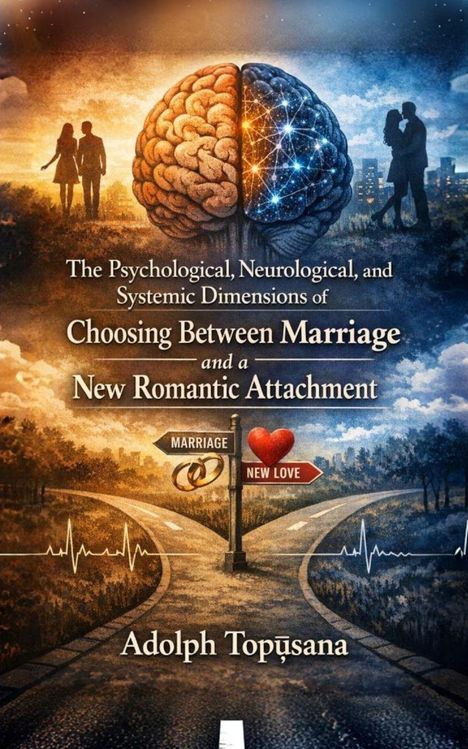
Adolph Top¿sana: The Psychological, Neurological, and Systemic Dimensions of Choosing Between Marriage and a New..., Kartoniert / Broschiert
The Psychological, Neurological, and Systemic Dimensions of Choosing Between Marriage and a New Romantic Attachment
(soweit verfügbar beim Lieferanten)
- Verlag:
- Advise the Heart, 07/2026
- Einband:
- Kartoniert / Broschiert
- Sprache:
- Englisch
- ISBN-13:
- 9798295867729
- Artikelnummer:
- 12810011
- Umfang:
- 44 Seiten
- Gewicht:
- 55 g
- Maße:
- 203 x 127 mm
- Stärke:
- 2 mm
- Erscheinungstermin:
- 23.7.2026
- Hinweis
-
Achtung: Artikel ist nicht in deutscher Sprache!
Klappentext
The decision to remain in a marriage or pursue the intoxicating pull of new love is not merely a matter of the heart-it is a collision of biology, psychology, and social architecture. The Psychological, Neurological, and Systemic Dimensions of Choosing Between Marriage and a New Romantic Attachment delves into one of the most destabilizing crossroads in adult emotional development: the moment when commitment meets temptation. Through a synthesis of neurobiological research, clinical frameworks, and sociological insight, this work reveals how the human brain, conditioned by attachment and reward systems, can betray the vows it once helped sustain. Drawing from the studies of Drs. John and Julie Gottman, Dr. William Doherty, and Esther Perel, the book dissects the phenomenon of "marital ambivalence"-a state where cognitive dissonance, emotional fatigue, and limerence converge to challenge fidelity. It explores how neurochemical shifts alter perception, how identity crises emerge within long-term unions, and how systemic factors-from cultural expectations to legal frameworks-shape the fallout of infidelity. Each chapter builds a multidimensional portrait of love's competing architectures: the enduring stability of marriage versus the electrifying novelty of new attachment. From the evolution of marital constructs and the neurobiology of desire to the structural interventions of discernment counseling, the text offers both scientific clarity and human empathy. This is not a guide to choosing sides-it is an invitation to understand the forces that make such choices agonizingly complex. For therapists, scholars, and anyone who has stood at the threshold between history and possibility, this book illuminates the hidden mechanics of devotion, betrayal, and the fragile hope of renewal.