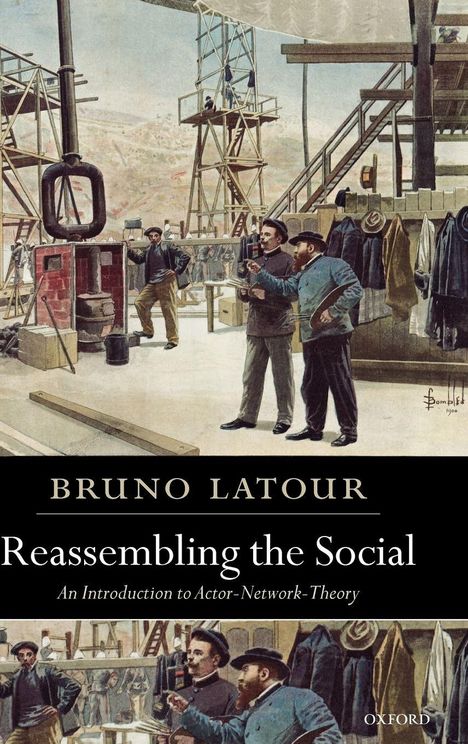
Bruno Latour: Reassembling the Social, Gebunden
Reassembling the Social
- An Introduction to Actor-Network-Theory
(soweit verfügbar beim Lieferanten)
- Verlag:
- OUP Oxford, 08/2005
- Einband:
- Gebunden
- Sprache:
- Englisch
- ISBN-13:
- 9780199256044
- Artikelnummer:
- 2543722
- Umfang:
- 312 Seiten
- Gewicht:
- 617 g
- Maße:
- 242 x 160 mm
- Stärke:
- 23 mm
- Erscheinungstermin:
- 1.8.2005
- Hinweis
-
Achtung: Artikel ist nicht in deutscher Sprache!
Weitere Ausgaben von Reassembling the Social |
Preis |
|---|
Klappentext
Reassembling the Social is a fundamental challenge from one of the world's leading social theorists to how we understand society and the 'social'.
Bruno Latour's contention is that the word 'social', as used by Social Scientists, has become laden with assumptions to the point where it has become misnomer. When the adjective is applied to a phenomenon, it is used to indicate a stablilized state of affairs, a bundle of ties that in due course may be used to account for another phenomenon. But Latour also finds the word used as if it described a type of material, in a comparable way to an adjective such as 'wooden' or 'steely'. Rather than simply indicating what is already assembled together, it is now used in a way that makes assumptions about the nature of what is assembled. It has become a word that designates two distinct things: a process of assembling; and a type of material, distinct from others.
Latour shows why 'the social' cannot be thought of as a kind of material or domain, and disputes attempts to provide a 'social explanations' of other states of affairs. While these attempts have been productive (and probably necessary) in the past, the very success of the social sciences mean that they are largely no longer so. At the present stage it is no longer possible to inspect the precise constituents entering the social domain.
Latour returns to the original meaning of 'the social' to redefine the notion, and allow it to trace connections again. It will then be possible to resume the traditional goal of the social sciences, but using more refined tools. Drawing on his extensive work examining the 'assemblages' of nature, Latour finds it necessary to scrutinize thoroughly the exact content of what is assembled under the umbrella of Society.
This approach, a 'sociology of associations', has become known as Actor-Network-Theory, and this book is an essential introduction both for those seeking to understand Actor-Network Theory, or the ideas of one of its most influential proponents.
Biografie
Bruno Latour wurde 1947 im der burgundischen Kleinstadt Beaune als Sohn einer Winzerfamilie geboren. Nach einem Studium der Philosophie und Anthropologie promovierte er 1975 an der Universität Tours. 1979 veröffentlichte Latour zusammen mit dem britischen Soziologen Steve Woolgar Laboratory Life, das Ergebnis seiner Feldstudien im Labor des späteren Nobelpreisträgers Roger Guillemin. Dabei konnte Latour aufzeigen, welche Rollen rhetorische Strategien und technische Artefakte bei der "Konstruktion wissenschaftlicher Tatsachen" spielen. Mit dem 1987 erschienenen Science in Action weitete Bruno Latour diese zunächst sozialkonstruktivistische Argumentation auf das Gebiet der Technik aus. Er entwickelte zusammen mit anderen Soziologen, vor allem Michel Callon und John Law, die Akteur-Netzwerk-Theorie, die über den Sozialkonstruktivismus hinausgeht. Anders als dieser geht die Akteur-Netzwerk-Theorie nicht davon aus, dass Technik und Wirklichkeit sozial konstruiert sind. Vielmehr wird davon ausgegangen, dass Technik/Natur und das Soziale sich in einem Netzwerk wechselseitig Eigenschaften und Handlungspotentiale zuschreiben. Latour entwickelte später auf Basis dieser Überlegungen mit "Wir sind nie modern gewesen" und "Das Parlament der Dinge" eine Kritik der "modernen" Gesellschaft. 1987 erfolgte die Habilitation an der Ecole des Hautes Etudes en Sciences Sociales. In den Science Wars der 90er Jahre wurde Latour unter anderem von Alan Sokal heftig kritisiert. In "Die Hoffnung der Pandora" setzte sich Latour mit dieser Kritik auseinander. 1982 wurde er Professor für Soziologie an der Ecole Nationale Supérieure des Mines in Paris. Neben seiner wissenschaftlichen Tätigkeit im engeren Sinne kuratierte er zusammen mit Peter Weibel die Ausstellungen Iconoclash (2002) und Making Things Public (2005) am Karlsruher Zentrum für Kunst und Medientechnologie. 2008 wurde Bruno Latour mit dem "Siegfried Unseld Preis" ausgezeichnet.