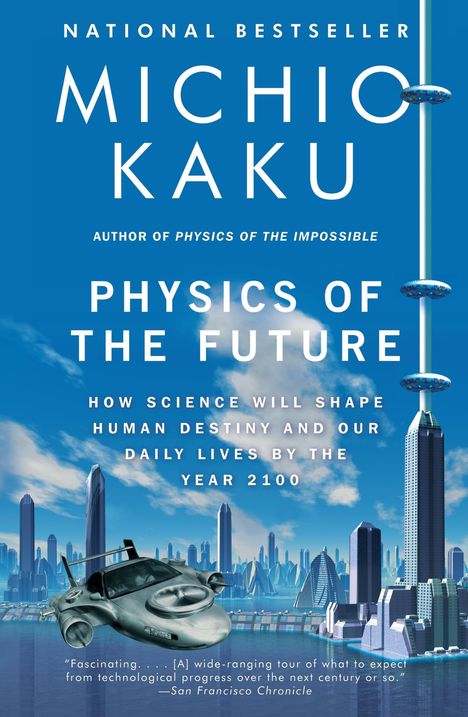
Michio Kaku: Physics of the Future: How Science Will Shape Human Destiny and Our Daily Lives by the Year 2100, Kartoniert / Broschiert
Physics of the Future: How Science Will Shape Human Destiny and Our Daily Lives by the Year 2100
- How Science Will Shape Human Destiny and Our Daily Lives by the Year 2100
(soweit verfügbar beim Lieferanten)
- Verlag:
- Knopf Doubleday Publishing Group, 02/2012
- Einband:
- Kartoniert / Broschiert
- Sprache:
- Englisch
- ISBN-13:
- 9780307473332
- Artikelnummer:
- 9622791
- Umfang:
- 480 Seiten
- Copyright-Jahr:
- 2012
- Gewicht:
- 454 g
- Maße:
- 203 x 130 mm
- Stärke:
- 27 mm
- Erscheinungstermin:
- 21.2.2012
- Hinweis
-
Achtung: Artikel ist nicht in deutscher Sprache!
Kurzbeschreibung
Uses interviews with numerous top scientists to offer a vision of the year 2100 and how the science of the day will shape society and the everyday lives of people.
Beschreibung
Space elevators. Internet-enabled contact lenses. Cars that fly by floating on magnetic fields. This is the stuff of science fiction - it's also daily life in the year 2100.
Renowned theoretical physicist Michio Kaku details the developments in computer technology, artificial intelligence, medicine, space travel, and more, that are poised to happen over the next hundred years. He also considers how these inventions will affect the world economy, addressing the key questions: Who will have jobs? Which nations will prosper? Kaku interviews three hundred of the world's top scientists - working in their labs on astonishing prototypes. He also takes into account the rigorous scientific principles that regulate how quickly, how safely, and how far technologies can advance. In Physics of the Future, Kaku forecasts a century of earthshaking advances in technology that could make even the last centuries' leaps and bounds seem insignificant.
Inhaltsangabe
ACKNOWLEDGEMENTS
INTRODUCTION Predicting the Next 100 years
FUTURE OF THE COMPUTER Mind over Matter
FUTURE OF AI Rise of the Machines
FUTURE OF MEDICINE Perfection and Beyond
NANOTECHNOLOGY Everything from Nothing?
FUTURE OF ENERGY Energy from the Stars
FUTURE OF SPACE TRAVEL To the Stars
FUTURE OF WEALTH Winners and Losers
FUTURE OF HUMANITY Planetary Civilization
A DAY IN THE LIFE IN 2100
NOTES
RECOMMENDED READING
INDEX
Rezension
"Fascinating. . . . [A] wide-ranging tour of what to expect from technological progress over the next century or so." - The Wall Street Journal
"A whirlwind tour of technological possibility." - New Scientist
"Mak[es] the exponential character of technological progress stick in the reader's head, so that they come to look at the world differently." - The Sunday Telegraph (London)
"[ Physics of the Future ] has the ability to surprise and enthrall and frighten." - The New York Times
"[Kaku] has the rare ability to take complicated scientific theories and turn them into readable tales about what our lives will be like in the future. . . . Fascinating. And just a little bit spooky." - USA Today
"Mind-bending. . . . [An] alternately fascinating and frightening book." - San Francisco Chronicle
"Kaku is a tireless science popularizer. . . . [He gets] the juices of future physicists flowing." - Los Angeles Times
"[Kaku] has a knack for making complex ideas entertaining." - The Charlotte Observer
"Erudite [and] compelling." - Chicago Tribune
"One cannot help but feel buoyed that the miraculous world the author presents may really be less than a hundred years hence." -- Louisville Courier-Journal
Klappentext
The "New York Times"-bestselling author of "Physics of the Impossible" offers a stunning and provocative vision of the future, and explains how science will shape human destiny and everyone's daily life by the year 2100.
Auszüge aus dem Buch
Introduction
Predicting the Next 100 Years
When I was a child, two experiences helped to shape the person I am today and spawned two passions that have helped to define my entire life.
First, when I was eight years old, I remember all the teachers buzzing with the latest news that a great scientist had just died. That night, the newspapers printed a picture of his office, with an unfinished manuscript on his desk. The caption read that the greatest scientist of our era could not finish his greatest masterpiece. What, I asked myself, could be so difficult that such a great scientist could not finish it? What could possibly be that complicated and that important? To me, eventually this became more fascinating than any murder mystery, more intriguing than any adventure story. I had to know what was in that unfinished manuscript.
Later, I found out that the name of this scientist was Albert Einstein and the unfinished manuscript was to be his crowning achievement, his attempt to create a "theory of everything," an equation, perhaps no more than one inch wide, that would unlock the secrets of the universe and perhaps allow him to "read the mind of God."
But the other pivotal experience from my childhood was when I watched the Saturday morning TV shows, especially the Flash Gordon series with Buster Crabbe. Every week, my nose was glued to the TV screen. I was magically transported to a mysterious world of space aliens, starships, ray gun battles, underwater cities, and monsters. I was hooked. This was my first exposure to the world of the future. Ever since, I've felt a childlike wonder when pondering the future.
But after watching every episode of the series, I began to realize that although Flash got all the accolades, it was the scientist Dr. Zarkov who actually made the series work. He invented the rocket ship, the invisibility shield, the power source for the city in the sky, etc. Without the scientist, there is no future. The handsome and the beautiful may earn the admiration of society, but all the wondrous inventions of the future are a by--product of the unsung, anonymous scientists.
Later, when I was in high school, I decided to follow in the footsteps of these great scientists and put some of my learning to the test. I wanted to be part of this great revolution that I knew would change the world. I decided to build an atom smasher. I asked my mother for permission to build a 2.3-million electron volt particle accelerator in the garage. She was a bit startled but gave me the okay. Then, I went to Westinghouse and Varian Associates, got 400 pounds of transformer steel, 22 miles of copper wire, and assembled a betatron accelerator in my mom's garage.
Previously, I had built a cloud chamber with a powerful magnetic field and photographed tracks of antimatter. But photographing antimatter was not enough. My goal now was to produce a beam of antimatter. The atom smasher's magnetic coils successfully produced a huge 10, 000 gauss magnetic field (about 20, 000 times the earth's magnetic field, which would in principle be enough to rip a hammer right out of your hand). The machine soaked up 6 kilowatts of power, draining all the electricity my house could provide. When I turned on the machine, I frequently blew out all the fuses in the house. (My poor mother must have wondered why she could not have a son who played football instead.)
So two passions have intrigued me my entire life: the desire to understand all the physical laws of the universe in a single coherent theory and the desire to see the future. Eventually, I realized that these two passions were actually complementary. The key to understanding the future is to grasp the fundamental laws of nature and then apply them to the inventions, machines, and therapies that will redefine our civilization far into the future.
There have been
Biografie
Michio Kaku, geb. 1947, ist Professor für Theoretische Physik an der New Yorker City University und hat die Stringtheorie mitentwickelt. Daneben hat er mehrere populärwissenschaftliche Bücher geschrieben und verfasst regelmäßig Beiträge für Zeitungen und Magazine, Hörfunk und Fernsehen.